

1
Transcripts are not operational memory
Long transcripts preserve words, but decisions, commitments, risks and open questions still have to be recovered manually.
 ClosedRoomActive developmentPRODUCT · LOCAL-FIRST MEETING INTELLIGENCEActive development · macOS
Turn meetings into operational memory. Record, transcribe and understand conversations on your Mac, then carry decisions, actions, risks and context across the project.
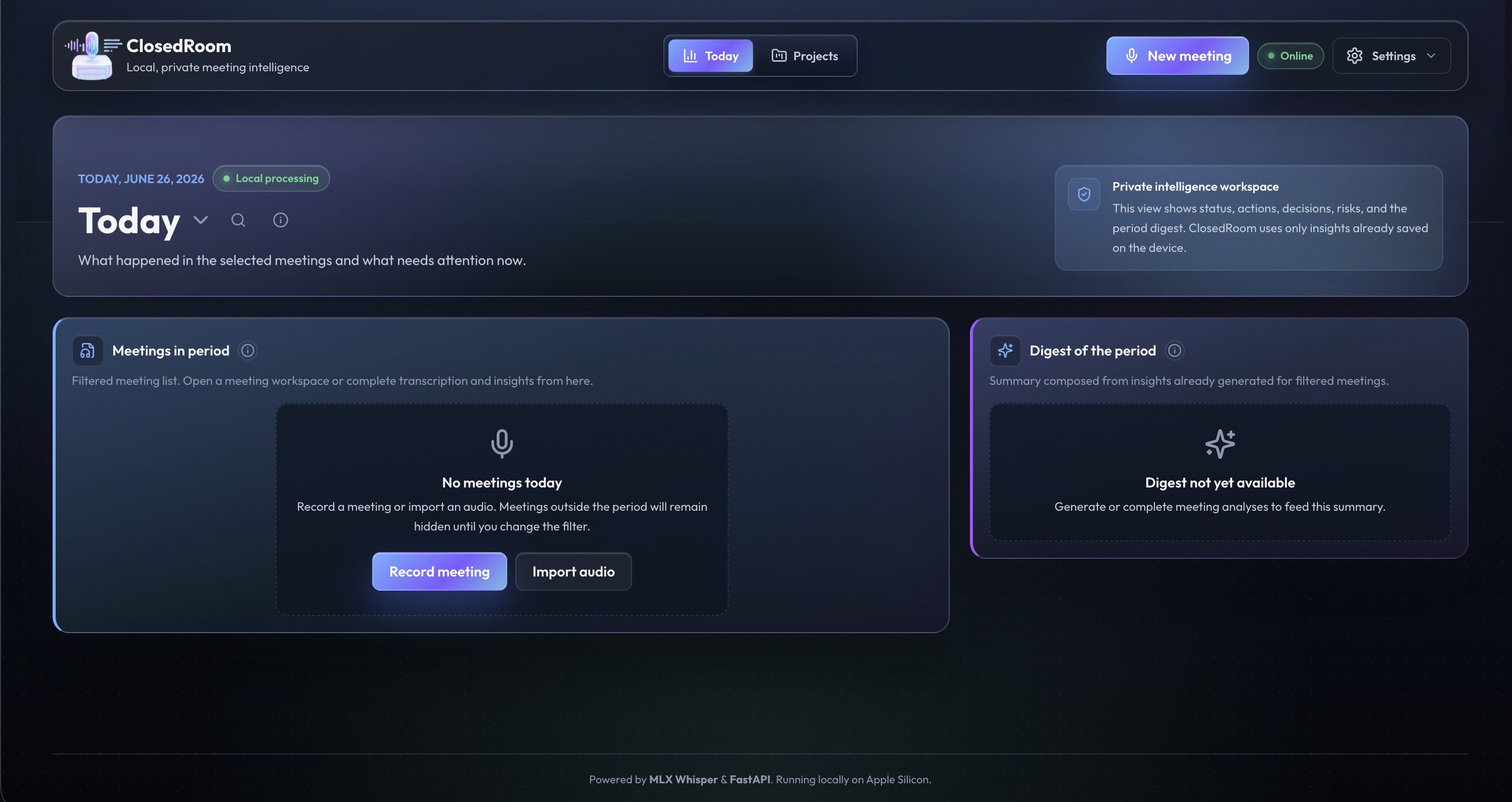
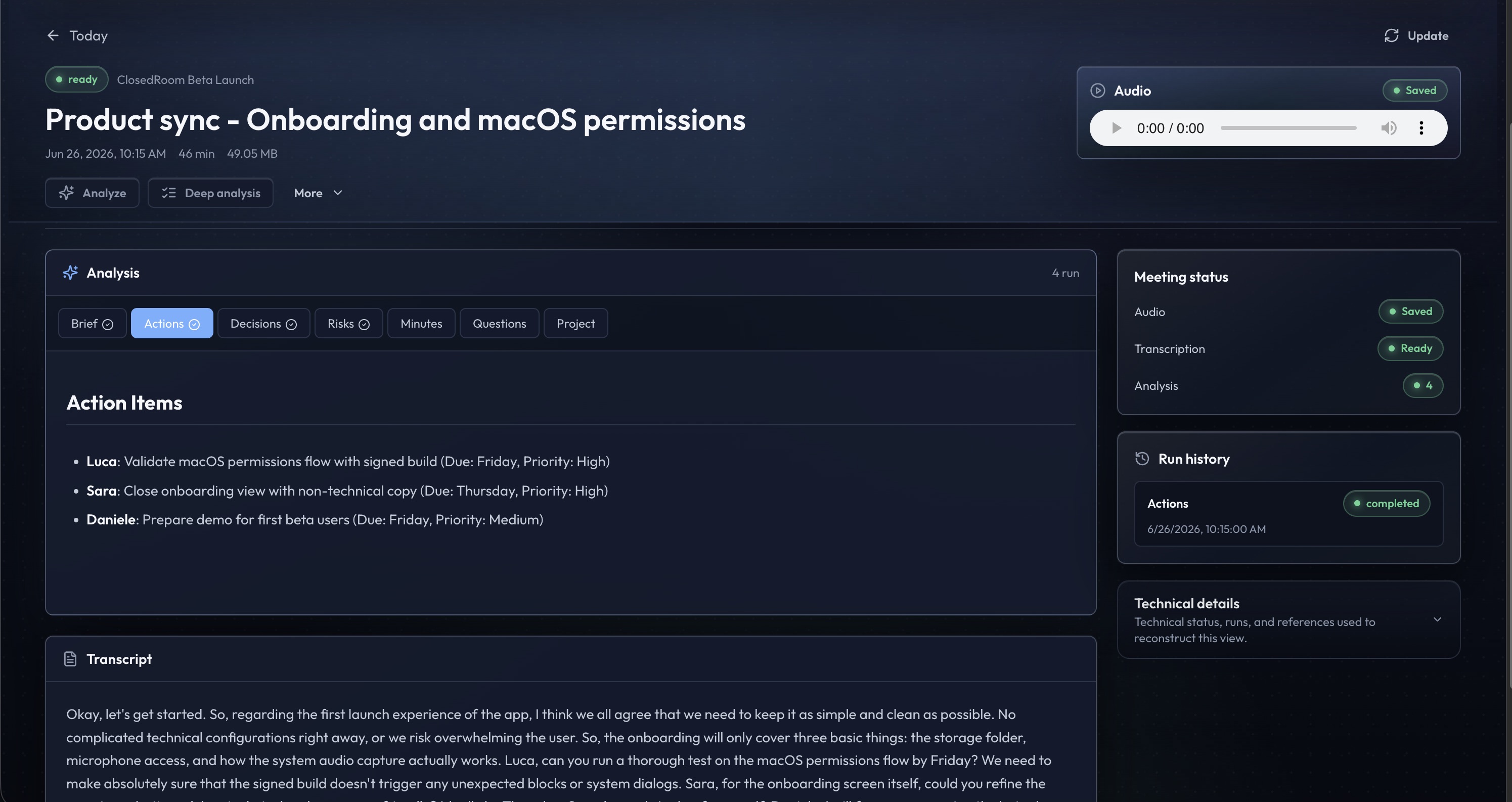
Record → Transcribe → Understand → Remember
The useful output is rarely the transcript itself. Teams need to recover what changed, what was decided, who owns what, which risks remain open and how the project evolved across several conversations.
Long transcripts preserve words, but decisions, commitments, risks and open questions still have to be recovered manually.
One meeting can explain one call. It does not automatically preserve the project state across a sequence of conversations.
Sensitive audio and transcripts can leave the machine before the user receives any useful intelligence or project context.
WHY CLOSEDROOM IS DIFFERENT
The product focuses on three outcomes that matter in real meeting workflows.
Sensitive meeting data stays on the Mac in the default path. External providers are explicit choices rather than hidden dependencies.
ClosedRoom turns conversations into speaker-aware transcripts, actions, decisions, risks, questions and editable notes.
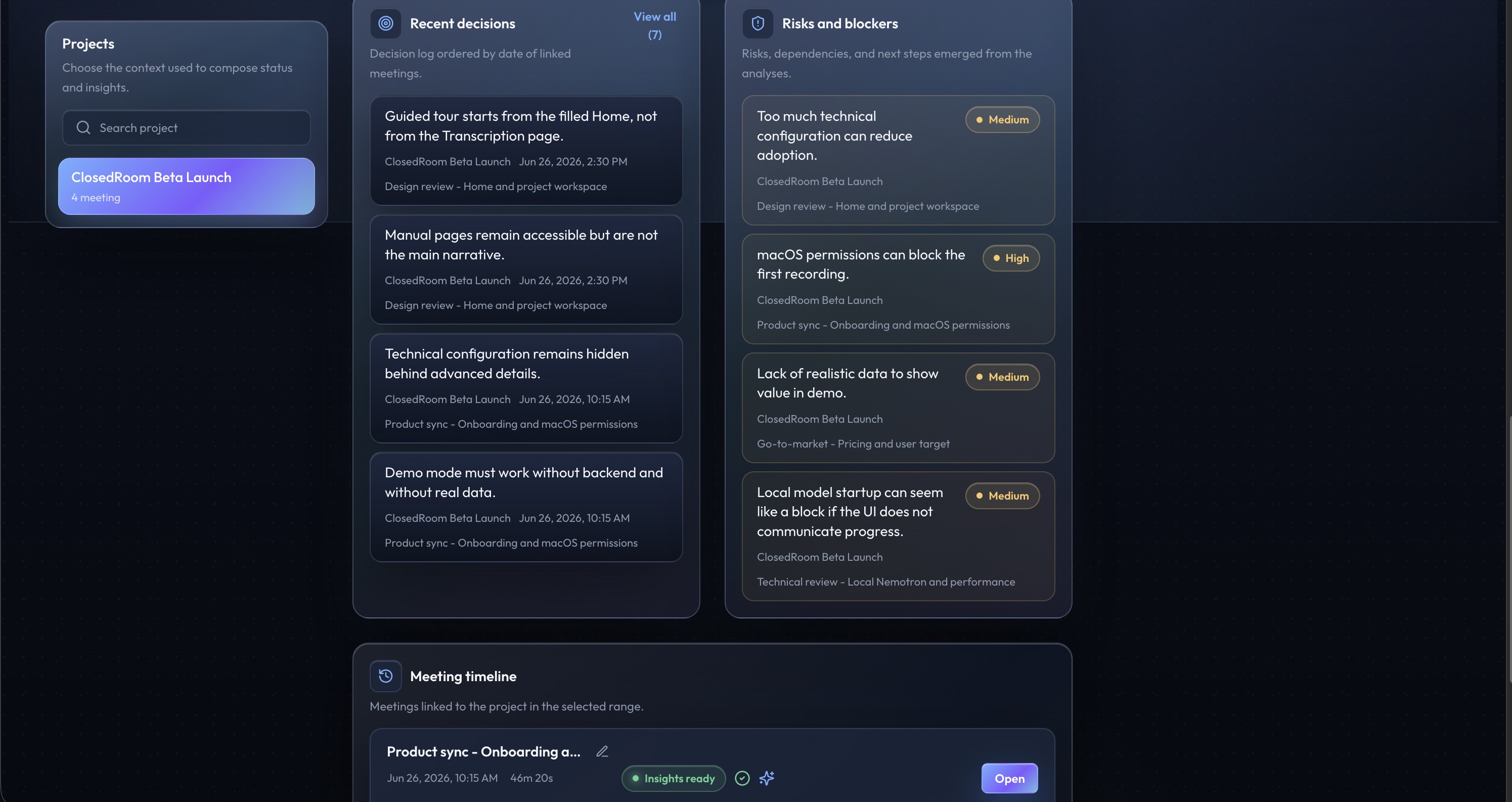
Outputs become reusable project context so commitments, risks and decisions do not disappear inside isolated meeting files.
HOW IT WORKS
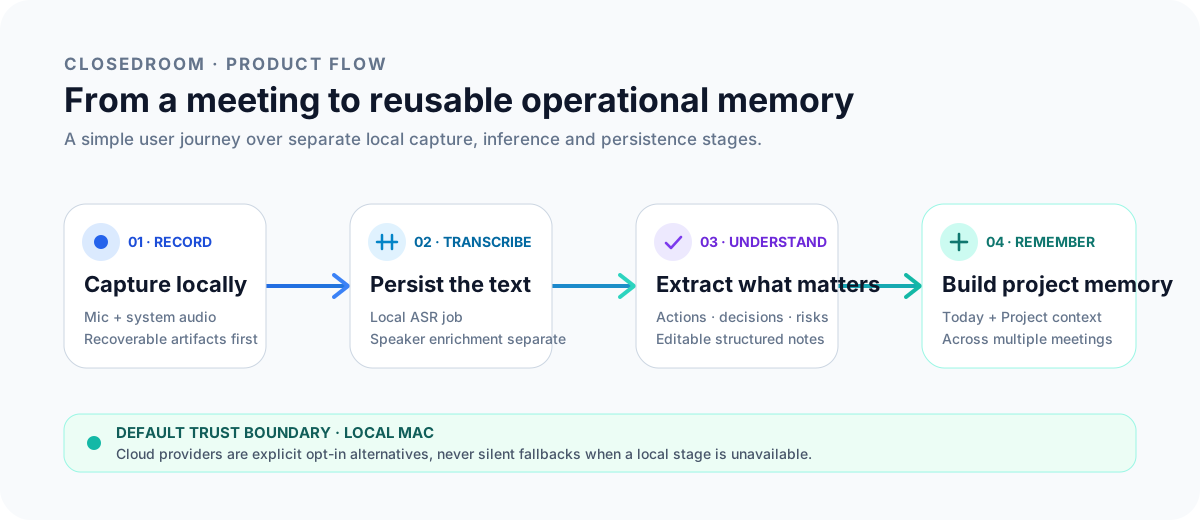
The user mental model stays simple even though capture, inference, enrichment and persistence remain separate engineering stages underneath.
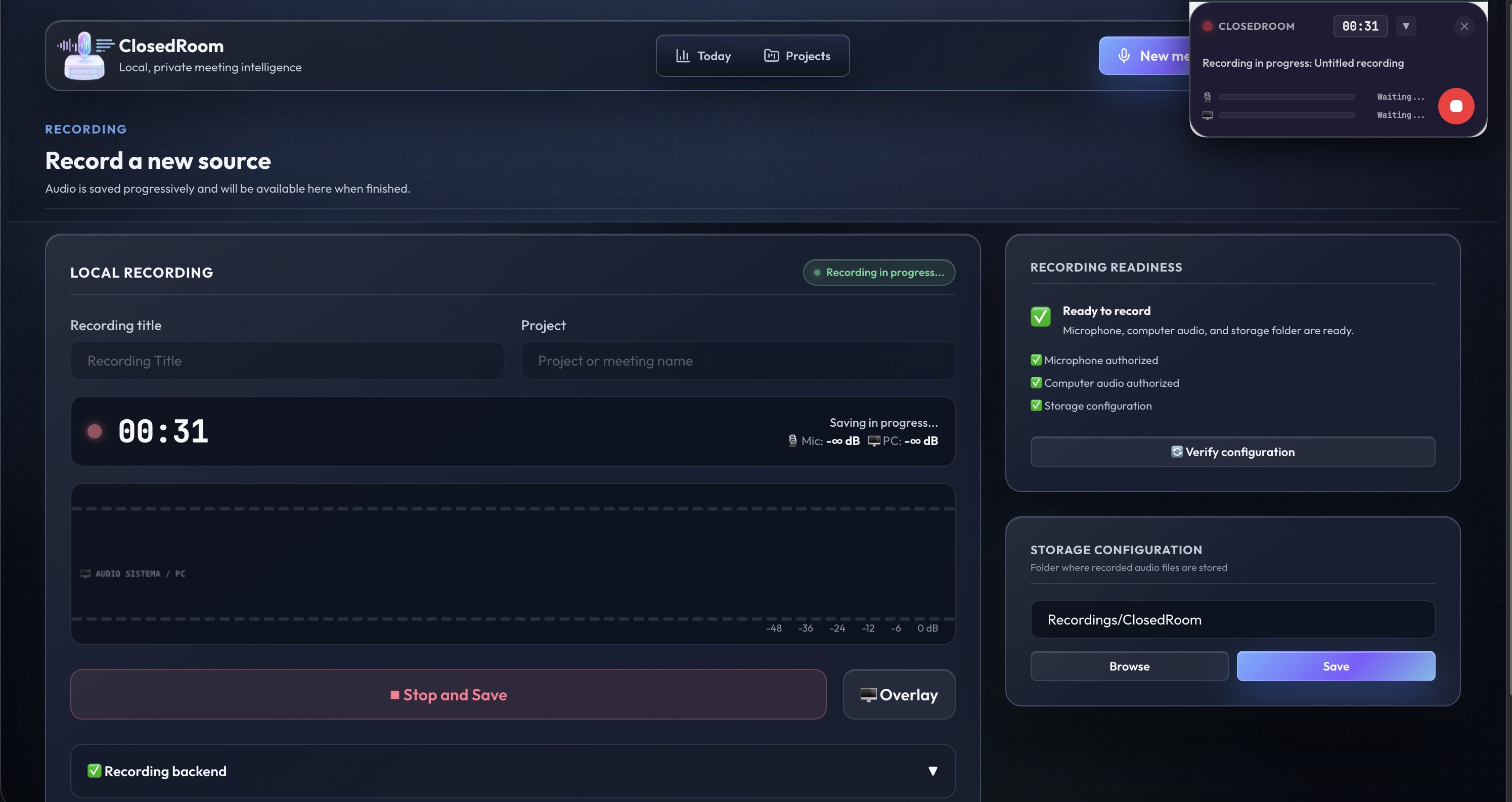
Capture microphone and system audio locally and persist recoverable meeting artifacts before expensive inference begins.
Run the local ASR path as a persisted, observable job. Speaker diarization remains a separate enrichment instead of a prerequisite.
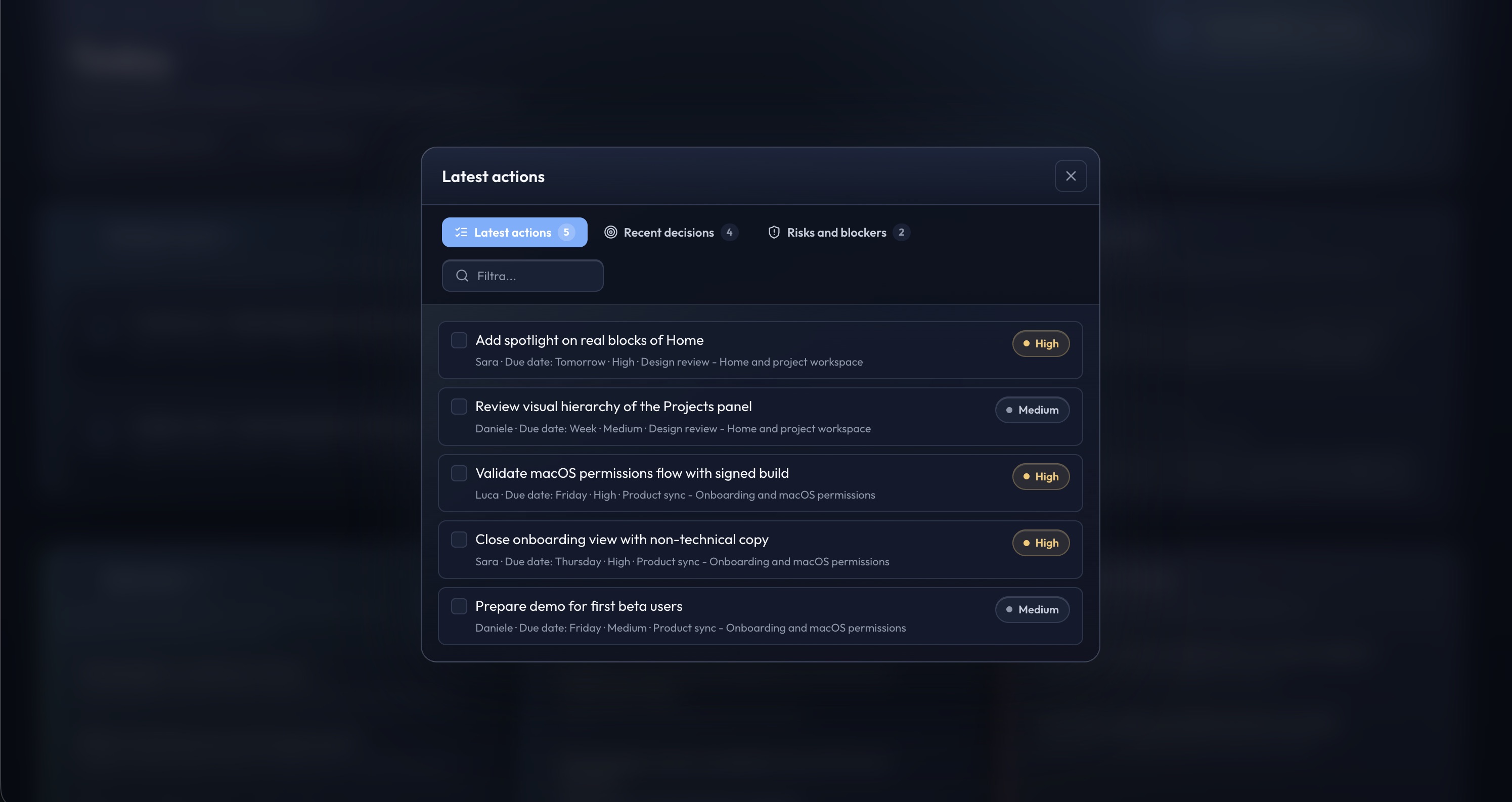
Turn the transcript into speaker-aware summaries, actions, decisions, risks, open questions and editable meeting notes.
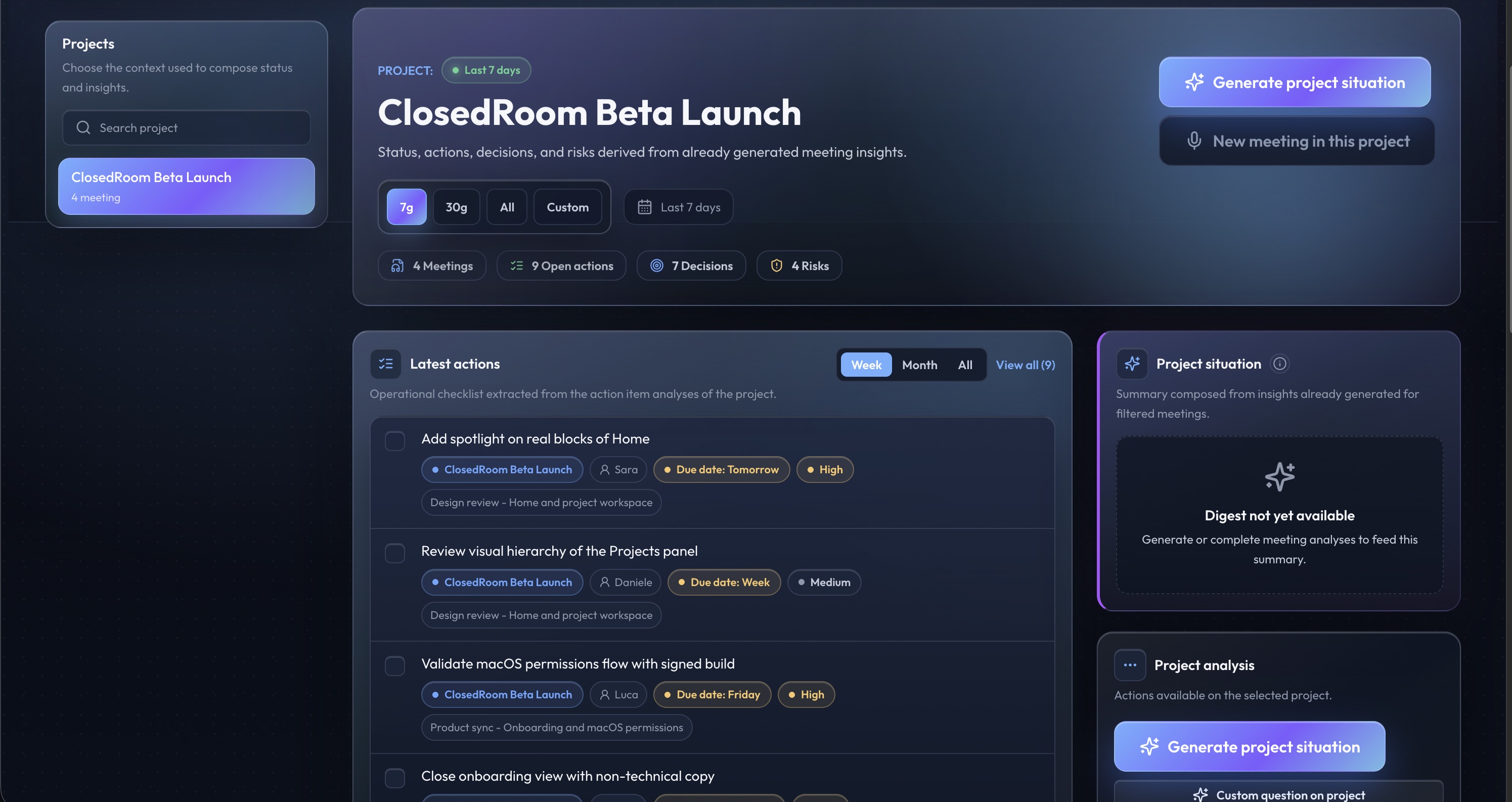
Reuse meeting outputs inside Today and Project views so current status and historical context survive beyond a single call.
THE PRODUCT
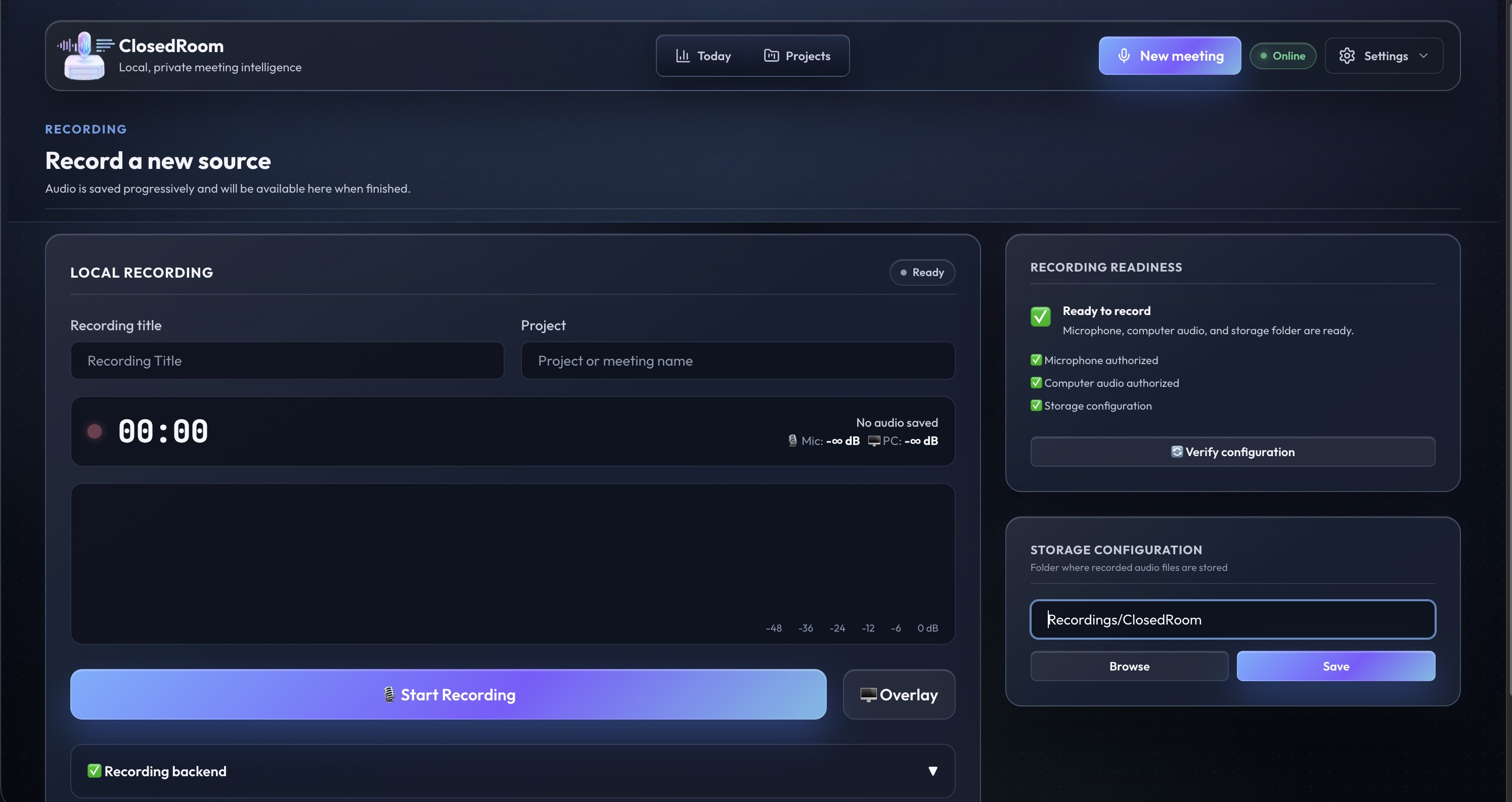
The product surfaces the whole operational path instead of treating transcription as the final destination.
ARCHITECTURE
The macOS app and loopback FastAPI boundary coordinate recording, jobs, persistence, ASR, diarization and meeting state. Korgis provides the reusable LLM/VLM execution boundary underneath the product workflow.
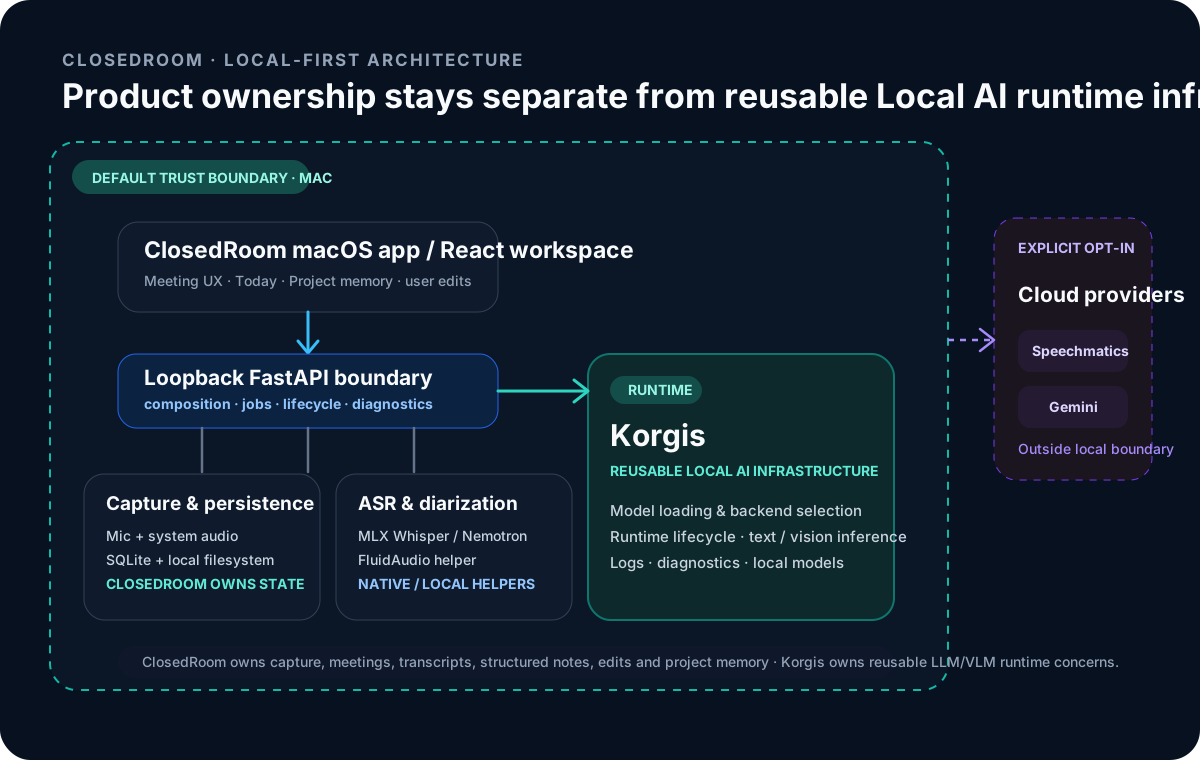
Capture, meetings, transcripts, speaker state, structured notes, user edits, persistence and project memory.
Model loading, backend selection, runtime lifecycle, text and vision inference, logs and diagnostics.
macOS capture and local diarization stay behind explicit process boundaries instead of leaking into product logic.
EVIDENCE & LIMITS
ClosedRoom already implements the core meeting-intelligence workflow and makes provider boundaries visible. Model quality, hardware behavior and broader privacy guarantees remain separate evidence questions.
Recording, local ASR, diarization, meeting analysis state, edits and project memory stay on the Mac in the default path.
Local filesystem · SQLite · local inference · KorgisSpeechmatics and Gemini can be selected intentionally. They are outside the default trust boundary and are never silent fallbacks.
Provider choice changes the data boundary visibly.EVIDENCE BOUNDARY
The product workflow and trust boundary are implemented; model and hardware claims stay scoped.
ClosedRoom persists meeting artifacts locally, supports local ASR and diarization paths, produces structured meeting intelligence, preserves user edits and carries outputs into project memory. Optional Speechmatics and Gemini paths are explicit opt-ins and can move selected meeting data outside the local boundary.
Supported today
Not claimed here
CONNECTED SYSTEM
CLOSEDROOM · MACOS
Explore the source-built macOS project, its Local AI boundaries and the engineering decisions behind the full meeting-to-memory workflow.