

01
Manual review is slow
Long documents make anonymization repetitive, expensive and inconsistent.
 RedactGuardDesktop · Korgis
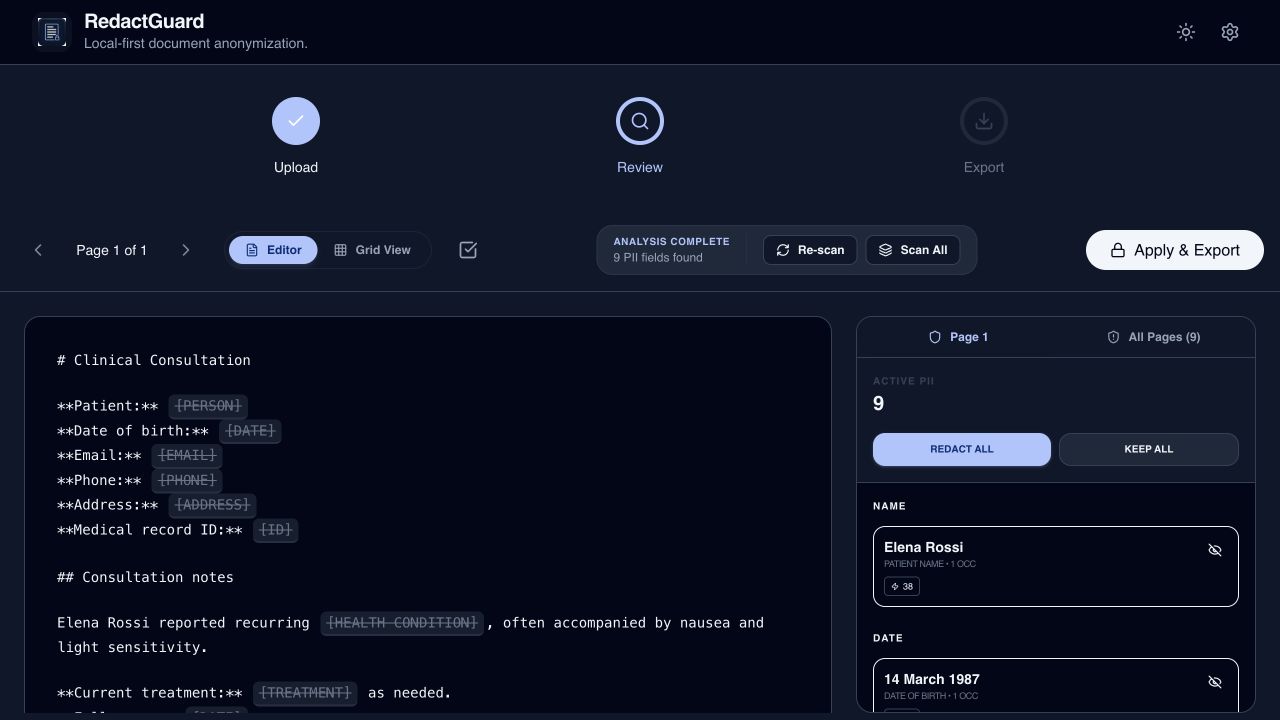
Detect configurable PII locally, review every finding, and export only the minimized document while keeping reusable local execution behind Korgis.
What must be protected changes by document, industry, organization and workflow. That makes detection both a privacy problem and a maintenance problem.
Long documents make anonymization repetitive, expensive and inconsistent.
New PII often means new regex, mappings, exceptions and application logic.
The original sensitive document must leave the machine before it can be analyzed.
RedactGuard owns the product problem — import, PII policy, review, redaction and export — while Korgis provides the reusable local AI execution boundary underneath it.
The result is a clearer separation between application workflow and local inference infrastructure, without making cloud AI the default path for sensitive content.
The desktop workflow stays visible and reversible until the user confirms the final redactions.
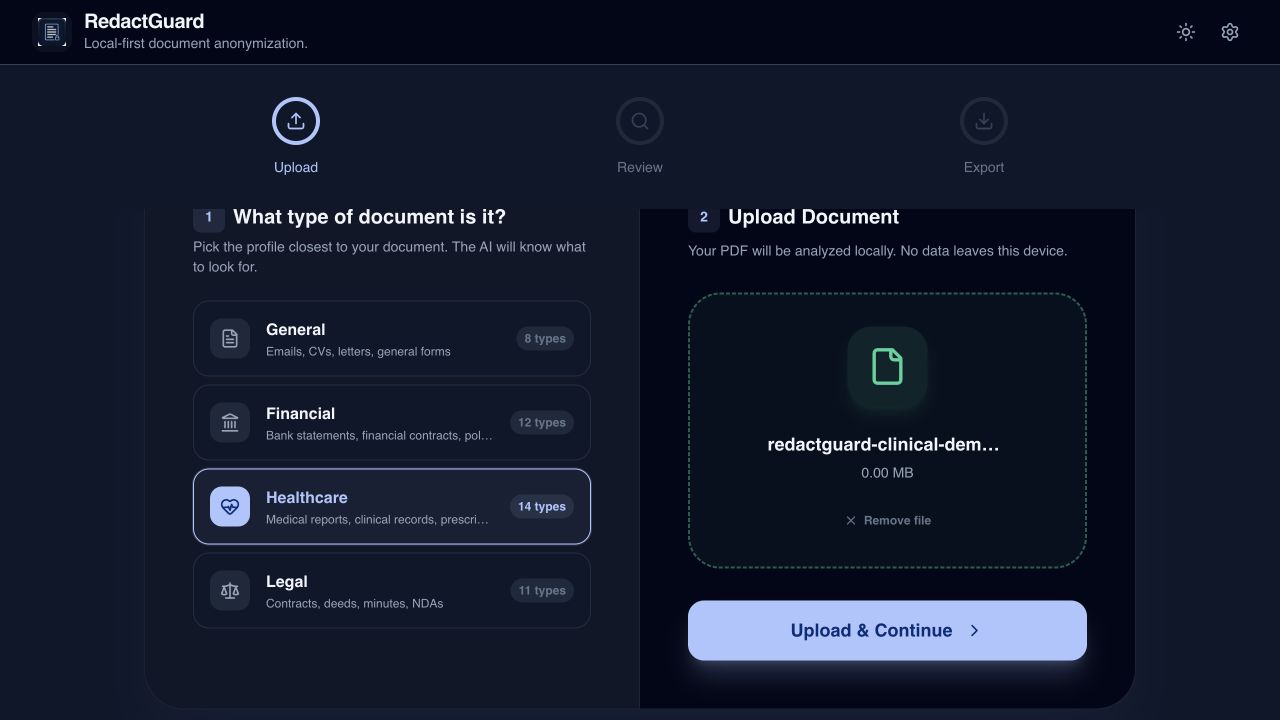
Start from a built-in domain profile or a custom detection definition.
Keep, remove or adjust what the local model identified as sensitive.
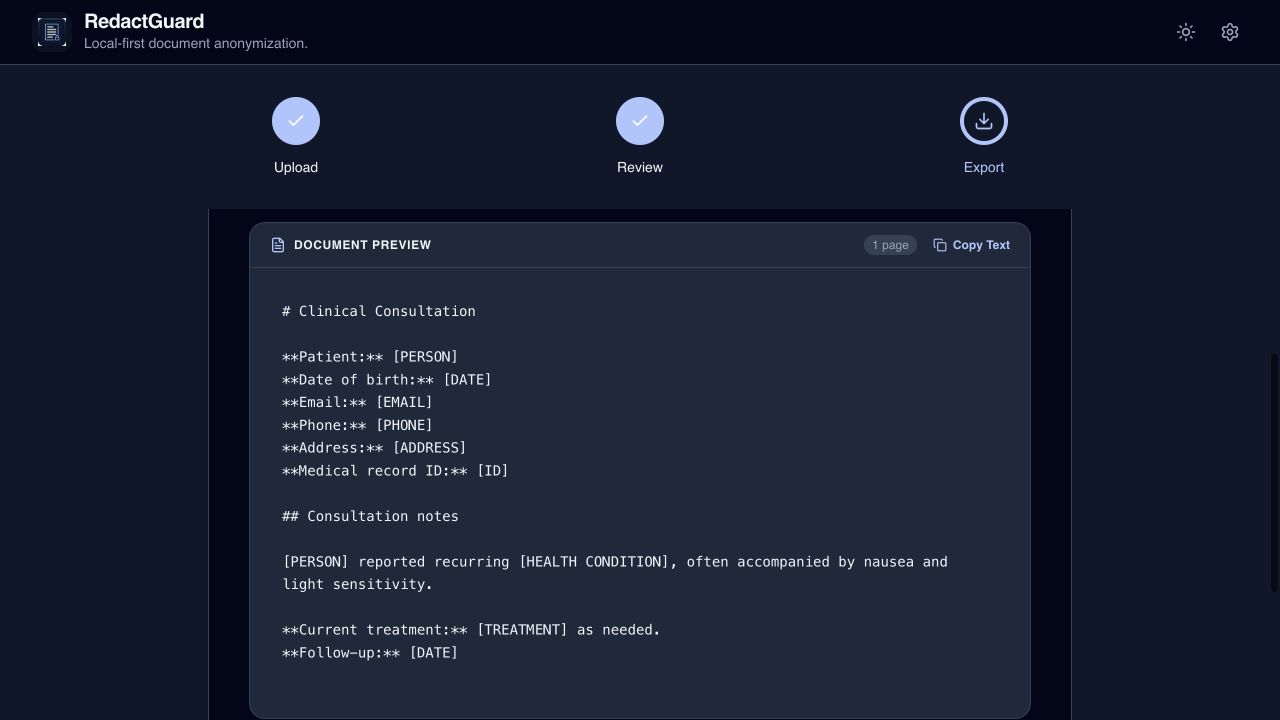
Export only after the redaction choices have been explicitly reviewed.
RedactGuard keeps document-specific responsibilities in the application and uses Korgis as the local AI backbone, so product logic and inference infrastructure do not collapse into one code path.
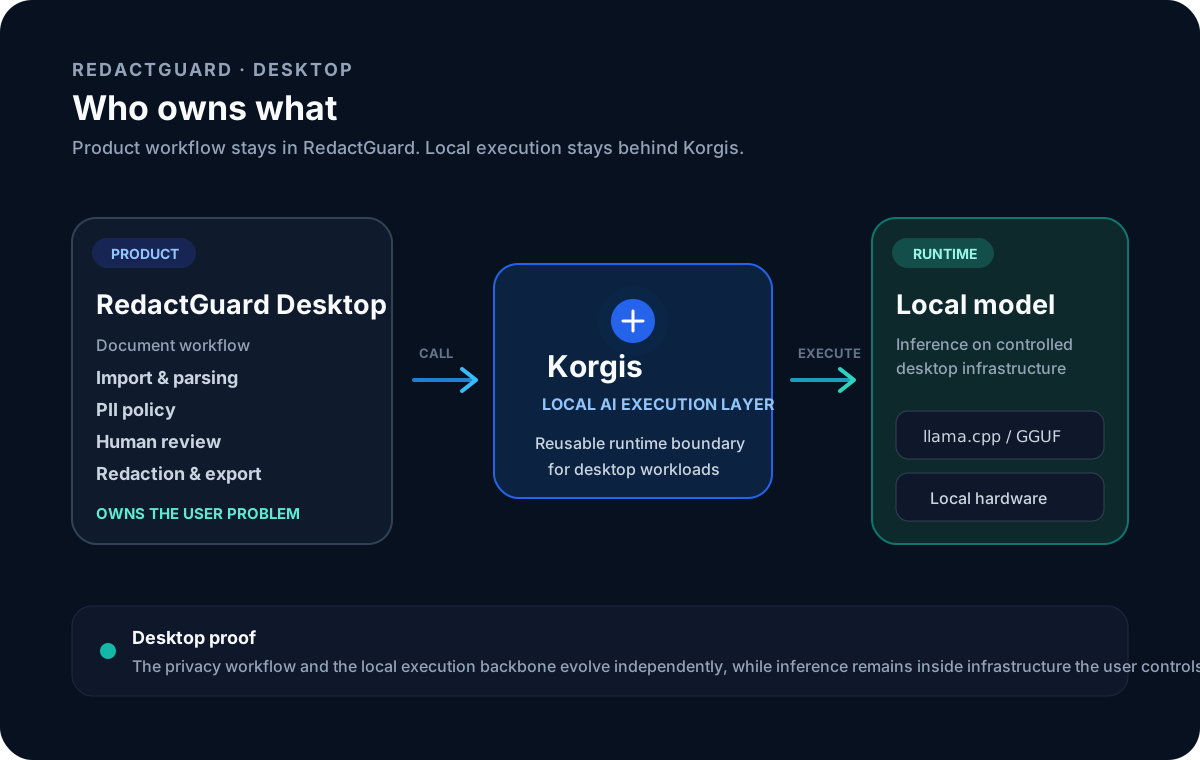
Owns import, document processing, PII policy, review, redaction and export.
Provides the reusable local AI execution boundary beneath the desktop workflow.
Runs the GGUF inference path on infrastructure controlled by the user.
RedactGuard is an experimental privacy tool, not a compliance guarantee. Local AI can miss, misclassify or over-detect sensitive information, so results still require human review.
EVIDENCE & LIMITS
RedactGuard treats reviewability as part of the product boundary: local inference can accelerate detection, but it does not turn the model into an autonomous privacy or compliance authority.
EVIDENCE BOUNDARY
Local, configurable and reviewable does not mean perfect.
The current desktop product supports configurable PII definitions, local execution through the Korgis boundary, reviewable findings and explicit export. The model can still miss, misclassify or over-detect sensitive information, so human review remains mandatory.
Supported today
Not claimed here
CONNECTED SYSTEM
The desktop variant separates the RedactGuard product workflow from the Korgis execution backbone, while keeping the final privacy decision with the user.