

1
Duplicated Engine Setup
Every app bundles its own runtime binaries, inflating APK size and multiplying maintenance overhead.
Harness is a Local AI Gateway for Android: one foundation for GGUF models, on-device inference, runtime lifecycle and diagnostics.
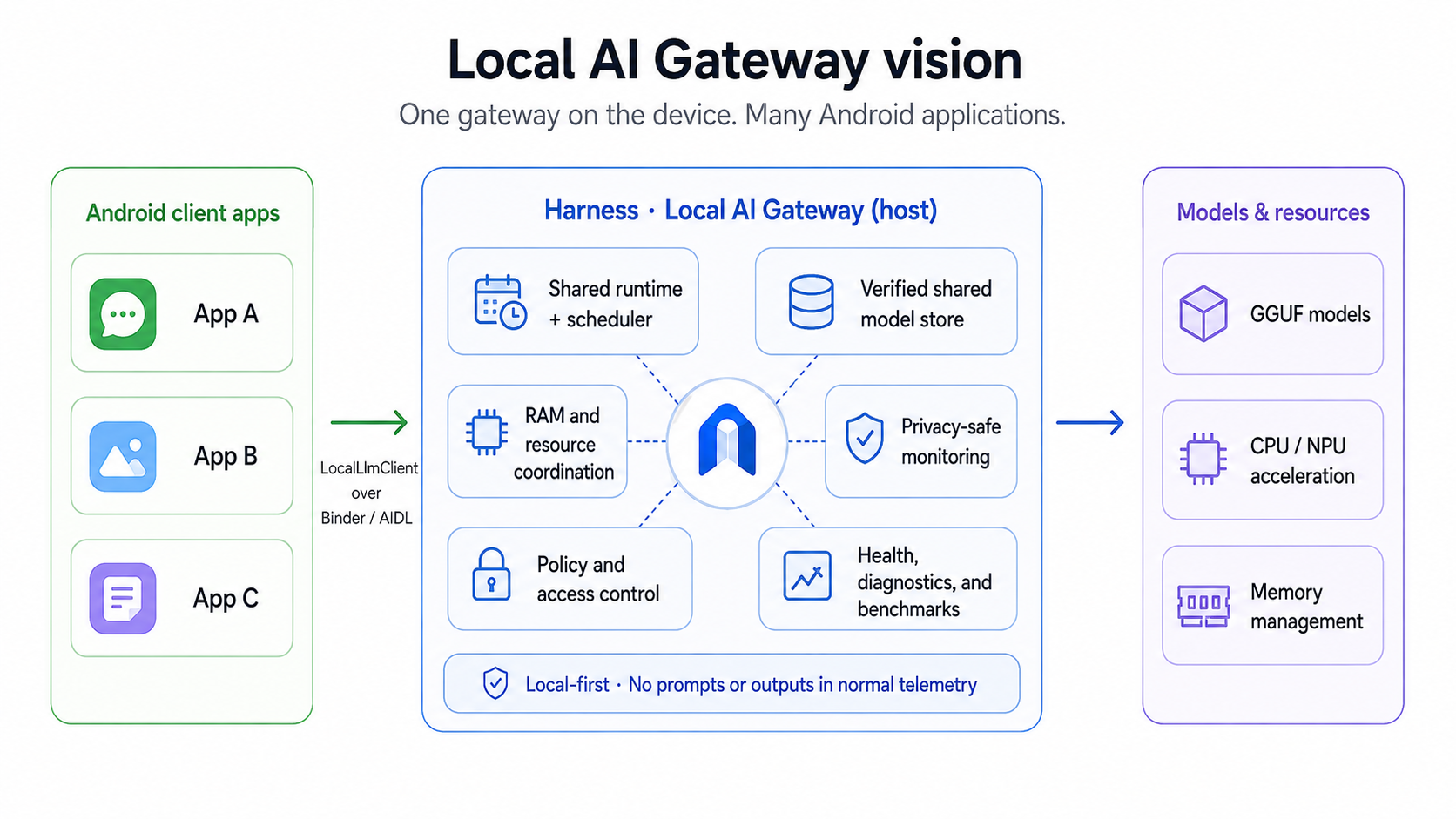
Running LLMs on-device shouldn't mean re-implementing model loading, memory limits, and runtime bindings in every single app. Harness abstracts on-device inference into an explicit system service.
Building local LLM features on mobile today comes with structural friction that impedes product reliability.
Every app bundles its own runtime binaries, inflating APK size and multiplying maintenance overhead.
On-device LLMs consume gigabytes of RAM. Without centralized management, apps crash silently under OOM conditions.
Integrating local AI into existing background services or third-party apps requires custom ad-hoc protocols.
Measuring prompt evaluation speed, generation latency, and thermal throttling requires dedicated telemetry.
Just as Android provides system services for location, camera, or network, Harness provides a system gateway for local LLM execution.
Store and manage GGUF quantized models in a centralized device location shared across applications.
Direct bindings to llama.cpp via JNI with hardware acceleration for ARM NEON and Vulkan GPU execution.
Expose thread-safe Android Binder interfaces so any app can stream tokens without runtime lock-in.
Harness connects runtime controls, model management, interactive testing, diagnostics and system settings into a unified mobile console.
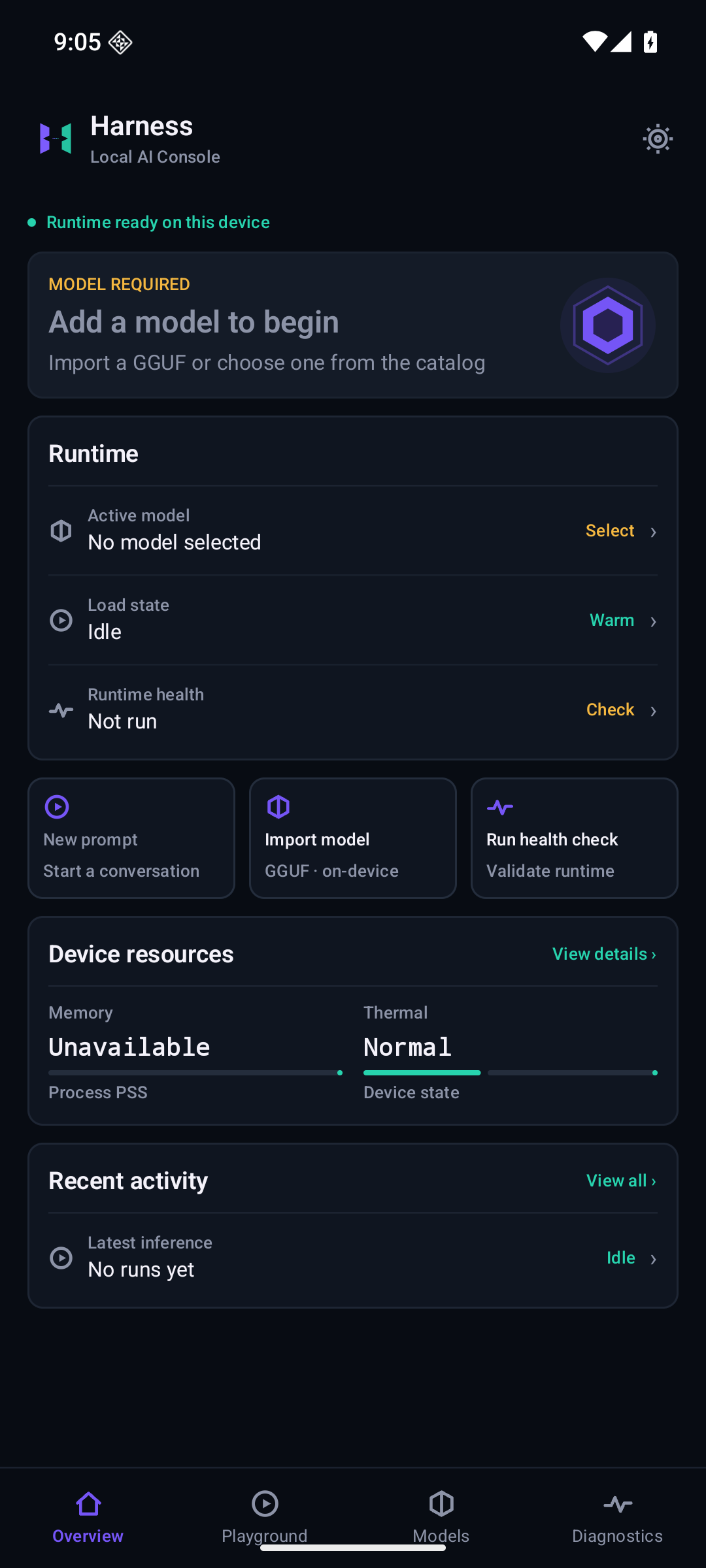
Runtime readiness, device resources and next valid action.
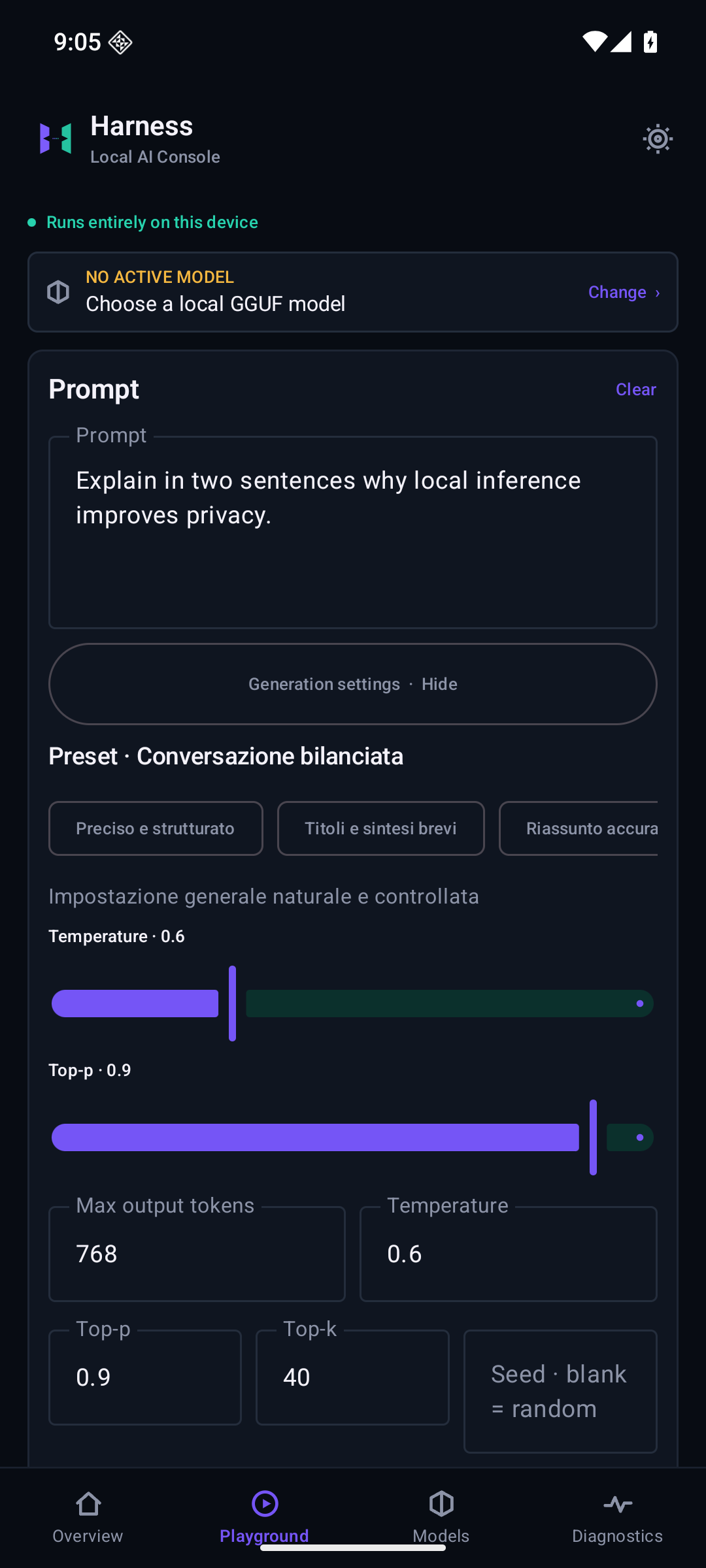
Prompt, configure, stream and cancel inference locally.
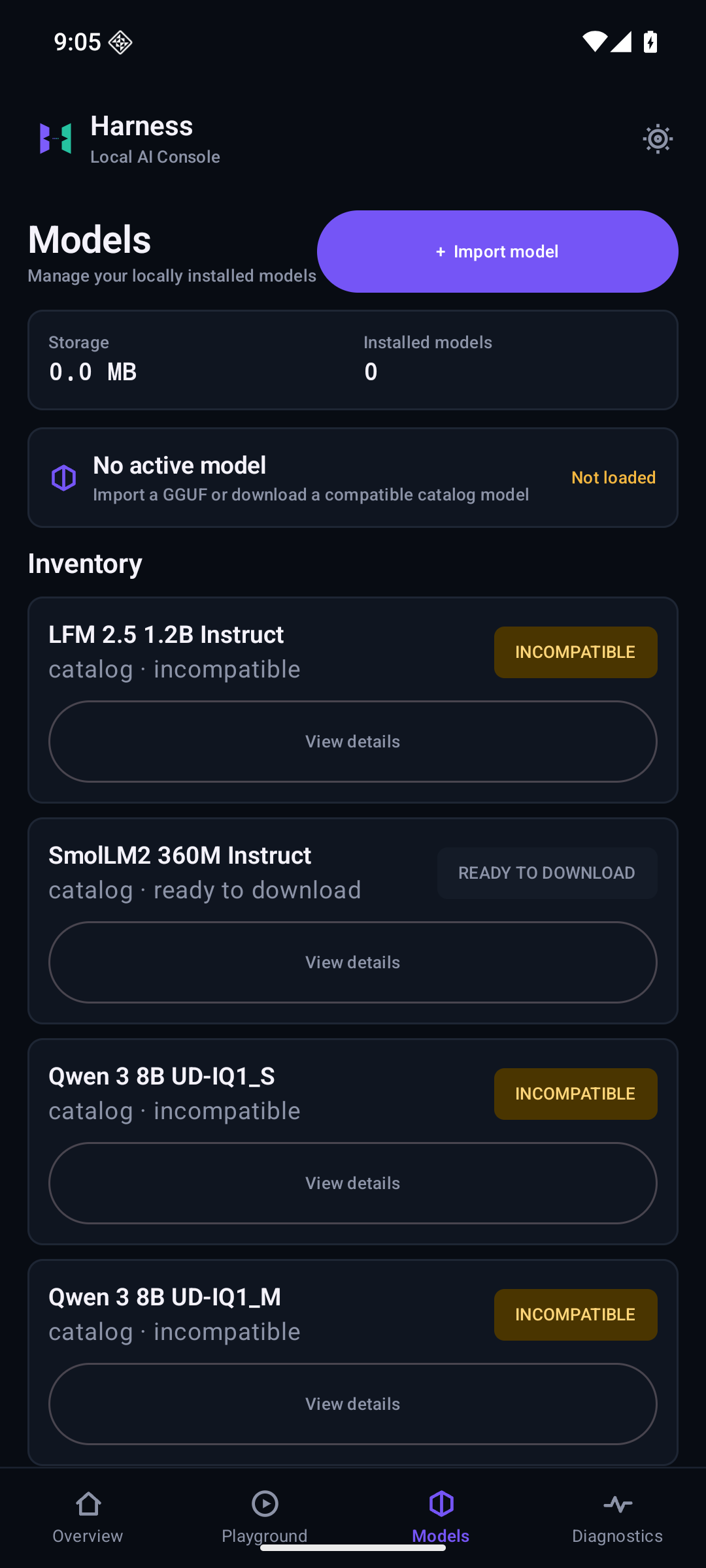
Import, download, verify, select and remove GGUF artifacts.
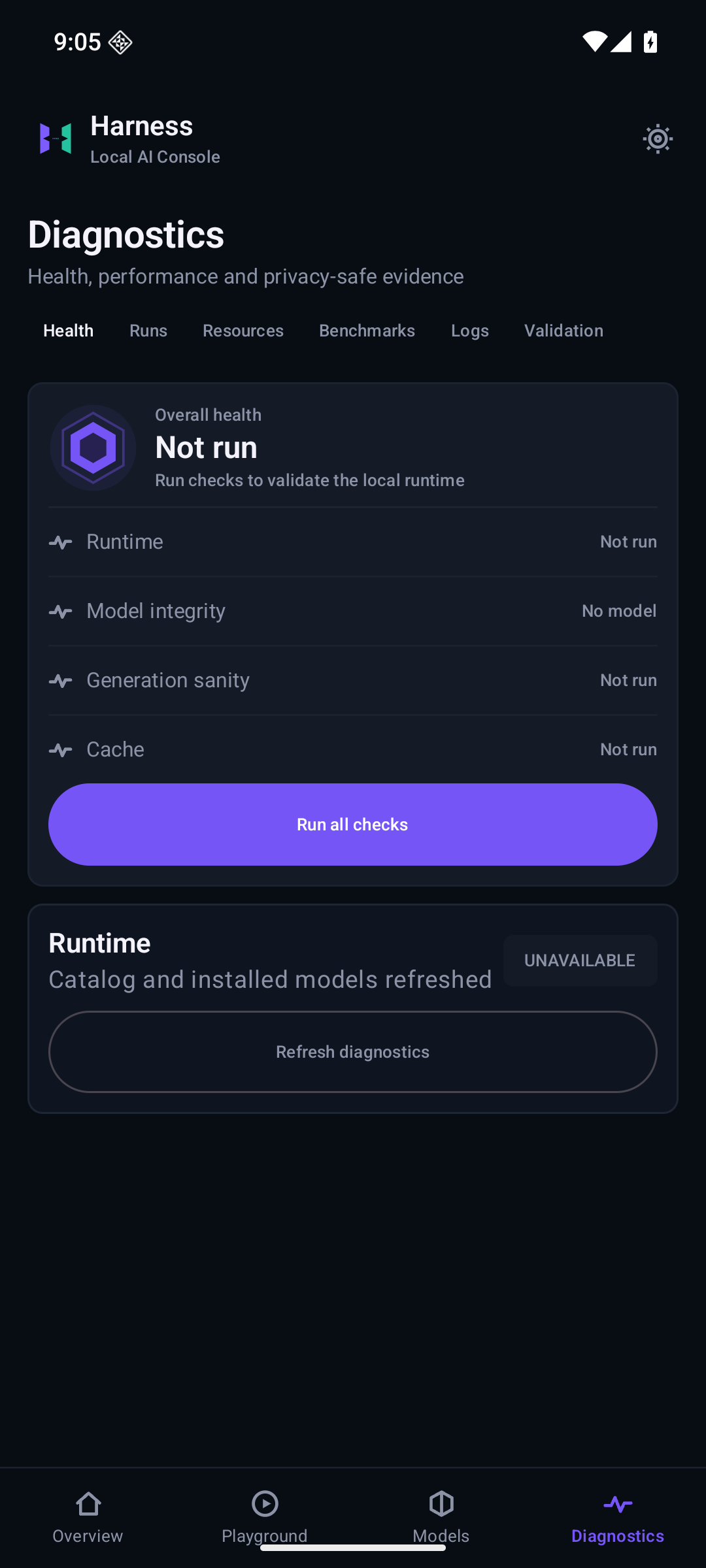
Runs, health, resources, logs and benchmarks.
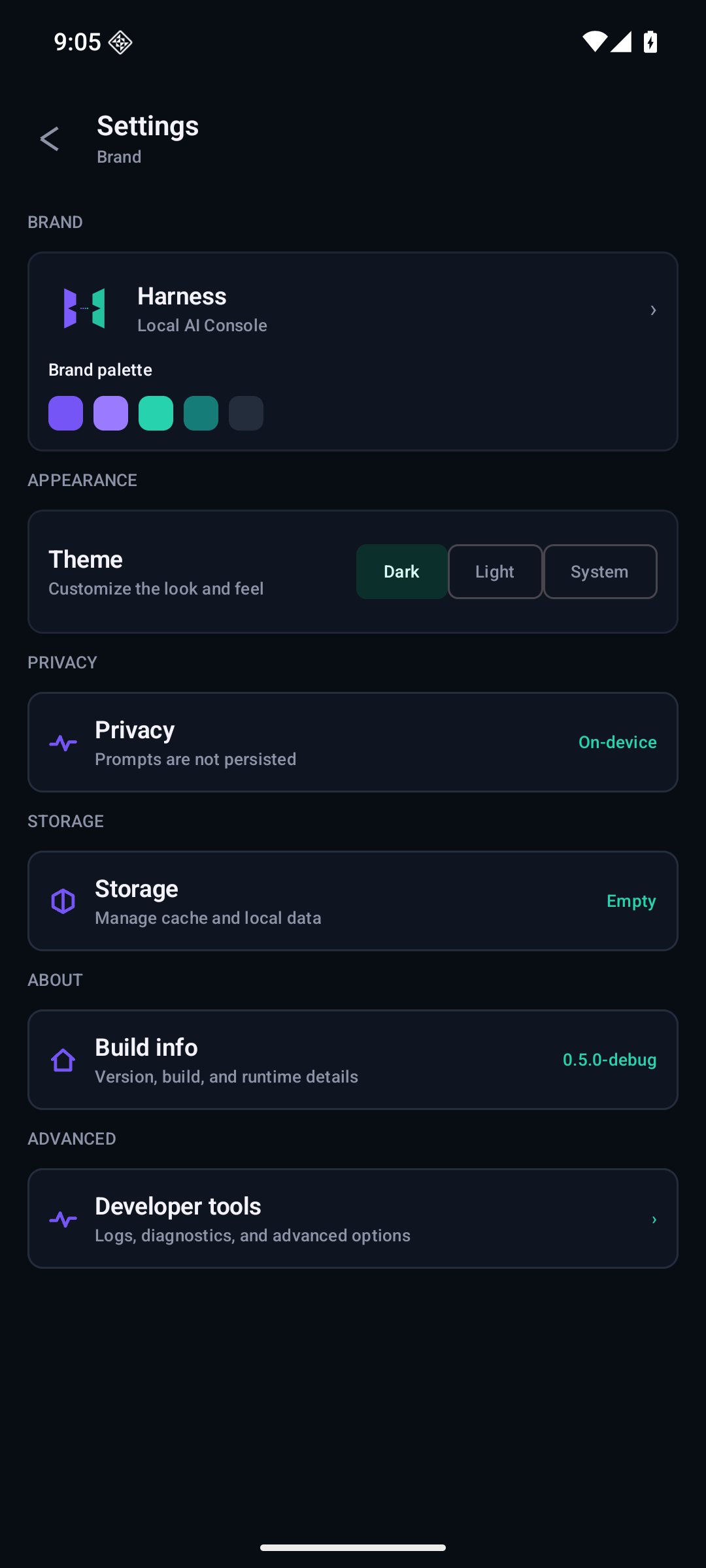
Privacy, storage, build information and developer controls.
The architecture is intentionally layered so the product surface, runtime contracts, model plane, native backend and observability can evolve without leaking implementation details into every client.
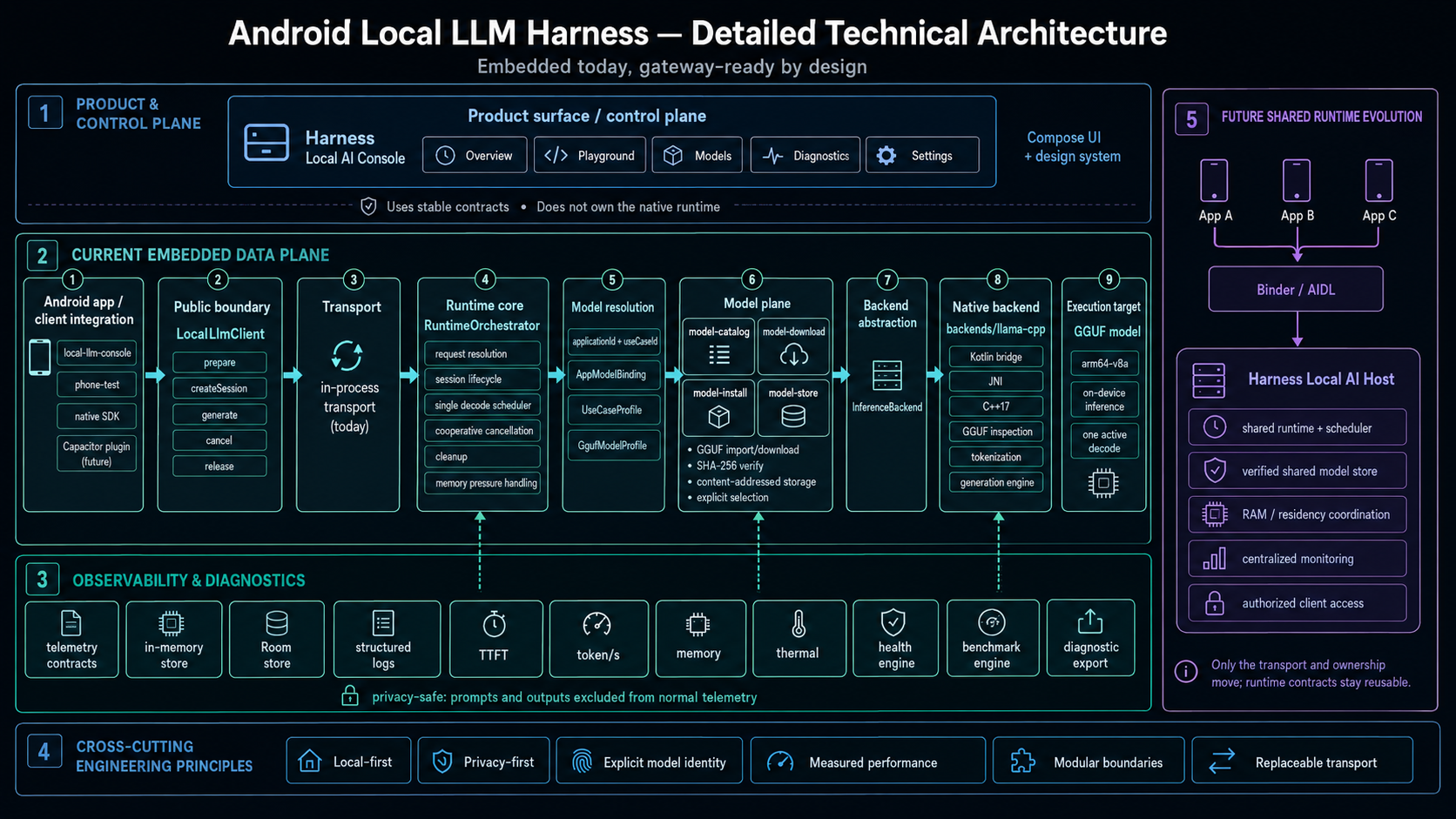
The product is organized around the qualities that make local AI useful after the first successful generation.
Inference runs on-device and normal telemetry excludes prompts and generated output.
The gateway vision centralizes model storage and resource ownership so multiple authorized apps can reuse infrastructure.
Latency, throughput, memory, thermal state, health and benchmarks make model choices inspectable.
Bindings, integrity, cancellation, failures and cleanup are explicit rather than hidden runtime assumptions.
Product contracts stay independent from llama.cpp internals, Android UI and transport details.
The target gateway adds one privacy-conscious control plane across local AI applications.
The sequence deliberately proves difficult runtime and model-management foundations before introducing cross-application IPC and shared ownership.
Distribution, storage, inference, cancellation, cleanup, diagnostics and real-device behavior.
Keep explicit application/use-case identity and backend-neutral domain contracts.
Protected Binder/AIDL transport plus a lightweight Android client integration.
Shared models, RAM coordination, scheduling, health and monitoring across authorized apps.
Applications depend on a neutral client and explicit identifiers rather than calling JNI directly. The target gateway keeps this interaction while moving backend ownership behind the host service.
val prepared = client.prepare(applicationId, useCaseId)
check(prepared.ready)

val sessionId = client.createSession(applicationId, useCaseId)
val handle = client.generate(
    request = generationRequest(sessionId, applicationId, useCaseId),
    listener = generationListener,
)

handle.cancel()Harness should not be presented as a production-ready Android inference platform yet. The current value is a connected console and tested foundation that de-risks the final gateway architecture.
Harness is part of a broader mission: move beyond isolated AI experiments and build product infrastructure that can be understood, evaluated and scaled deliberately.